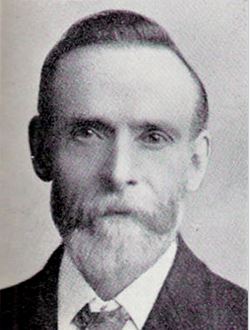
General
Secretary of the
Amalgamated
Society of Carpenters and Joiners 1888 - 1919
Francis
Chandler, born at Harrow, Middlesex, in 1849, was at
14 years of age apprenticed as a joiner at a shop in Notting Hill, London . He early realised the
value of combination, and on May 17th, 1869, a few months before he reached his
twentieth year, joined the Ealing Branch of the A.S.C. & J. Later, Francis
transferred to Hammersmith Branch, of which in 1872 he was elected secretary,
holding the office for 16 years until he was called to be the head of the society. From the first, Francis was an indefatigable
worker for the organisation and played an important
part in trade-unionising the London Building
Industry. He represented Ealing Branch at the ” Brown
Bear” meetings held in London to consider and combat demands made by the
building trade employers, and had as a colleague the late Henry Broadhurst,
representing the Stone Masons’ Society. In 1876 Francis succeeded Charles
Matkin (brother of the late G.S. of the General Union of Carpenters and
Joiners) as secretary of the London United Trades Committee, of which William
Matkin was also a member at that time. During his term as secretary of the
L.U.T.C., a movement was carried through to secure due notice of discharge,
i.e., “grinding time,” to allow operatives time in which to gather up and put
in order their tools. At that period the A.S.C. & J. had no rule against
piecework, although the system was growing in disfavour
with most trade-unionists. The L.U.T.C. began an
agitation about piecework and succeeded in passing a district rule for its
abolition. This did not meet with the approval or support of the Executive Council who, although
against the system, argued that the A.S.C. & J. was not strong enough in
the London district to enforce the rule and that its effect would be the victimisation of the members. We have related the story of
the Manchester strike of 1877, and London played a worthy part in helping to
finance this twelve months’ struggle. Upon Francis devolved the onerous work of arranging
meetings for the Manchester delegates to address, and of organising
shop and job collections throughout the London district. As a result between £50 and £60 a week was sent from London to
Manchester each week while the strike lasted. The work described was all done
by Francis during
his spare time and in addition to his daily work as a joiner, and it told so
seriously upon his health that when the time came for re-election of the
L.U.T.C. he felt constrained to decline nomination. During 1876 Francis was elected
to the General Council, attending his first meeting in Manchester while the
strike was in progress, and serving on the Council
continuously until his election to the General
Secretaryship in 1888.
For many
years, since his first election in 1895, Francis served on the Parliamentary
Committee of the Trades Union Congress, and was sent as a fraternal delegate in
1901 to the Annual Convention of the American Federation of Labour,
held at Scranton , U.S.A. In 1894 he was elected to
the Manchester Board of Guardians, and did useful work
in the capacity of Poor Law Guardian for many years. The year following he was
made a Justice of the Peace for the City of Manchester . Francis was the second of the General
Secretaries to have the honour of being appointed a
member of a Royal Commission. He will go down to
posterity as one who signed the famous Minority Report of that Commission which
elaborated far-reaching and drastic proposals for the remodelling
of the antiquated Poor Law system. Francis relinquished the reins of office in June, 1919, at 70 years of age, having been a member of the
society for 50 years-47 years of this term he had served the society
uninterruptedly in an official capacity, and 30 years of it he had, as General
Secretary, played a worthy part in shaping its destinies. He died on October
6th, 1937, having completed 70 years’ membership of the society.